Wood, Wire and Wonder: The Quiet Revolution in Britain's Instrument Workshops
The Sound of Patience
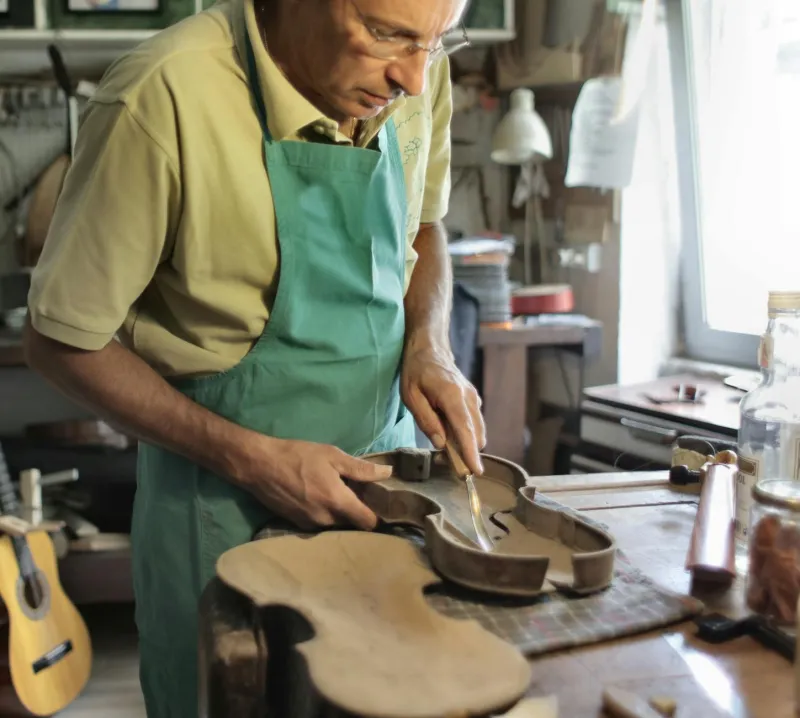
In a converted cow shed outside Totnes, Martin Woodhouse is doing something that would horrify any efficiency expert: he's spending three weeks making a single guitar. Not because he's slow, but because the spruce top he's shaping has been seasoning for fifteen years, and rushing it now would be like serving a fine wine before its time.
"This piece of wood came from a tree that was probably planted when Victoria was on the throne," he says, running his fingers along the grain. "It's seen more history than most humans. The least I can do is give it the time it deserves."
Woodhouse represents a quiet revolution happening in workshops across Britain. While global manufacturers churn out instruments by the thousand, a growing network of luthiers – instrument makers – are proving that handcrafted still means something in our mass-produced world.
The Workshop Renaissance
From Edinburgh to Cornwall, Britain's instrument makers are experiencing an unexpected renaissance. Not despite the dominance of factory production, but because of it. Musicians who've grown up with identical instruments are seeking something unique, something that bears the fingerprints of its maker.
"Every guitar that comes out of a factory is designed to be perfect," explains Emma Patterson, who builds violins in a converted railway arch in Sheffield. "But perfect can be boring. Handmade instruments have character – quirks and qualities that make them individuals, not products."
Patterson learned her craft through a seven-year apprenticeship that began when she was sixteen. Now thirty-four, she has a two-year waiting list for her instruments, which sell for between £3,000 and £8,000. "It's not about the money," she insists. "It's about creating something that will outlive me, that will make music long after I'm gone."
The Touch and Feel Revolution
What sets handmade instruments apart isn't just craftsmanship – it's the relationship between maker and player. When Glasgow-based mandolin builder James McKenzie creates an instrument, he spends hours with the musician who's commissioned it, understanding their playing style, their musical preferences, even their physical characteristics.
"A factory guitar is built for an average player who doesn't exist," McKenzie explains. "I'm building for this specific person, with their hand size, their playing strength, their musical goals. It's bespoke in the truest sense."
This personalisation extends beyond ergonomics to tonal qualities. McKenzie sources his wood from Scottish timber merchants, often visiting forests to select trees himself. "Different woods have different voices," he says. "My job is matching the right voice to the right musician."
Tradition Meets Innovation
Britain's luthiers aren't museum pieces preserving ancient crafts unchanged. They're innovators working within traditional frameworks, using centuries-old techniques to solve contemporary problems.
In her Derbyshire workshop, Celtic harp maker Sarah Thompson has developed new bracing patterns that allow her instruments to project better in modern concert halls. "Medieval halls were smaller, more intimate," she explains. "Today's harps need to fill spaces the original makers never imagined."
Thompson's innovations come from understanding both historical techniques and contemporary acoustics. She's studied surviving medieval harps in museums across Europe, but she's also worked with sound engineers to optimise her designs for modern performance spaces.
The Economics of Excellence
The business model of Britain's luthiers challenges conventional wisdom about efficiency and scale. While a factory can produce hundreds of guitars per week, Patterson completes perhaps twenty violins per year. Yet both she and her clients consider this a feature, not a bug.
"Scarcity creates value," notes Dr. Rebecca Walsh, who studies craft industries at Birmingham University. "But it's not artificial scarcity – it's the natural result of genuine craftsmanship. These instruments take time because the process can't be rushed without compromising quality."
The waiting lists that most established luthiers maintain – often stretching two to three years – reflect this reality. "I could expand, hire assistants, increase production," says Woodhouse. "But then I wouldn't be a craftsman anymore. I'd be a small factory, and the world has enough of those."
The Next Generation
Perhaps the most encouraging sign for Britain's instrument-making tradition is the steady stream of young people choosing apprenticeships over university degrees. At the London College of Furniture, the musical instrument technology course has a waiting list despite offering no guarantee of employment.
"These young people understand something important," observes course leader Professor David Chen. "They want to make things with their hands, to see the direct result of their labour. In an increasingly digital world, that's becoming more valuable, not less."
Twenty-two-year-old apprentice Tom Bradley is learning violin making in Patterson's Sheffield workshop. "My mates think I'm mad," he admits. "They're doing computer science, business studies, things that lead to 'proper' jobs. But I'm learning to create something beautiful that will last centuries. How is that not a proper job?"
The Sound of Authenticity
For musicians who play handmade instruments, the difference is immediately apparent. Folk singer Kate Morrison has played both factory and handmade guitars professionally. "There's no contest," she says. "The handmade guitar responds to my touch in ways a factory instrument never could. It's like the difference between a conversation and a monologue."
This responsiveness comes from the maker's deep understanding of how wood, metal, and air interact to create sound. "A factory guitar is engineered to specifications," explains Woodhouse. "A handmade guitar is crafted to sing. The difference might be subtle to a listener, but it's profound to the player."
Preserving the Future
As Britain's luthiers look ahead, they see both challenges and opportunities. Rising material costs and workshop rents threaten smaller makers, while increasing global awareness of their craft opens new markets. The key, most agree, is maintaining the standards that make their work special.
"We're not trying to compete with factories on price or speed," reflects Patterson. "We're offering something completely different – instruments with souls, with stories, with the irreplaceable mark of human hands and hearts."
In workshops from the Highlands to the Home Counties, Britain's instrument makers continue their patient work, shaping wood and wire into music's future. Each instrument they complete is a small act of resistance against the homogenisation of our mass-produced world, proof that in an age of algorithms, the human touch still matters most.