Ink on Paper, Stars in Hand: The Twilight Years of Britain's Autograph Obsessives
Ink on Paper, Stars in Hand: The Twilight Years of Britain's Autograph Obsessives
The stage door of a London West End theatre at half past ten on a Wednesday night is a specific kind of social theatre all of its own. A small crowd, breath misting in the autumn air, programmes clutched in gloved hands. Some are tourists who've stumbled upon the ritual by accident. Others are clearly regulars — they know which exit to stand near, they've brought a Sharpie as a backup, they recognise each other with the nod of fellow initiates.
Among them, if you know what to look for, are the serious ones. Not celebrity hunters or opportunists. Collectors. People for whom the signed programme or photograph is not a trophy but a document — a physical record of an encounter, a piece of cultural history rendered tactile by the pressure of a pen.
A Very British Habit
Autograph collecting in Britain has a history that predates the modern concept of celebrity entirely. Victorians collected signatures of politicians, writers, and composers with the same earnest enthusiasm that later generations would bring to pop stars and television personalities. The impulse is the same across the centuries: to possess something that the famous person has physically touched, to collapse the distance between admirer and admired into a single pen stroke.
By the post-war decades, it had become a genuinely mass pursuit. Children waited outside BBC Television Centre with autograph books. Teenagers stood in the rain outside Granada Studios in Manchester. The stage door of any theatre with a recognisable name above it would draw a faithful crowd. It was, in retrospect, a remarkably democratic ritual — no money required, no special access, just patience and the willingness to wait.
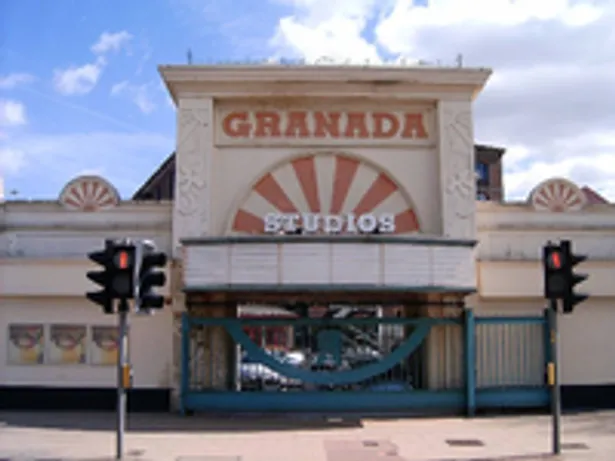 Photo: Granada Studios, via i2-prod.manchestereveningnews.co.uk
The collectors who pursued it most seriously were always a subset of this broader culture. These were the people who moved beyond the casual scrapbook into something more systematic — cataloguing, researching provenance, building collections around specific themes or periods, and developing what can only be described as a connoisseur's eye for what constitutes a genuinely significant signature.
What Makes a Signature Worth Having
Ask a serious collector what they're looking for and you quickly discover that 'autograph' is a deceptively simple word for a surprisingly complex object. Provenance matters enormously — a signed photograph obtained in person, with a clear record of when and where, carries a different weight from one acquired at auction with uncertain origins. The quality of the signature itself matters: collectors talk about 'exemplary' examples, signatures that capture something of the personality or the period, as opposed to the tired scrawl of someone who's signed ten thousand identical items for merchandise purposes.
Condition is everything. A beautifully preserved programme signed backstage at a 1960s Palladium show, in crisp ink on clean paper, is a genuinely moving object. The same signature on a water-damaged scrap tells a lesser story.
There's also the question of rarity. Signatures from performers who were notoriously reluctant to sign — or who died young, or who simply weren't prolific signers during their working lives — carry obvious premium. Collectors trade in this knowledge with the fluency of wine merchants discussing vintages.
The Ethics of the Signed Item
The hobby is not without its complications, and the most serious collectors are often the most candid about them. The secondary market for celebrity autographs has always attracted forgery, and the rise of professional authentication services has not entirely solved the problem — indeed, some collectors express scepticism about the authentication industry itself, arguing that certificates of authenticity have become commodities as susceptible to abuse as the signatures they're meant to validate.
There's also the thornier question of how celebrities feel about the whole enterprise. The dedicated collector who waits patiently at a stage door and asks politely for a single signature is a very different proposition from the 'dealer hunter' who attends every public appearance with a stack of items to be signed for resale. Performers and their management are increasingly alive to this distinction, and the atmosphere at stage doors has shifted accordingly — more wariness, more refusals, less of the easy generosity that characterised an earlier era.
And then there's the selfie problem. For many celebrities, the photograph taken on a fan's phone has simply replaced the signed item as the preferred mode of interaction. It's quicker, it requires no pen, and it produces something the fan can immediately share. The autograph, by contrast, demands a moment of genuine attention — the celebrity must stop, hold a pen, and actually write something. In an age of compressed attention and relentless schedules, that ask has quietly become more significant.
The Scrapbooks That History Forgot
What the collectors preserve, whatever one thinks of the hobby's quirks, is genuinely irreplaceable. Spend an afternoon with someone who's been collecting seriously since the 1970s and you'll find yourself looking at signed photographs of performers who are now largely forgotten by mainstream culture but were once household names — variety artists, radio personalities, character actors who spent forty years making British television what it was without ever becoming famous enough to warrant a biography.
These scrapbooks are, in a very real sense, social history. They record not just who was famous but who people valued enough to wait for, who was generous enough to stop, and what the texture of British entertainment culture felt like at specific moments in time. The handwriting itself tells stories — you can see the difference between a signature dashed off in a hurry and one given with genuine warmth.
Digital archives are wonderful things, but they don't carry the faint smell of old paper and ink, and they don't show you the slight indentation where the pen pressed through the page.
What Comes Next
The community of serious collectors is ageing, and there's no particular evidence that younger generations are taking it up in comparable numbers. The stage door still draws crowds, but the dominant impulse now is the raised phone, not the extended programme. The autograph book has become something of a period object — charming, slightly eccentric, redolent of a different relationship between public and performer.
That's not necessarily a tragedy. Cultures evolve, rituals change, and the selfie is its own kind of document. But something is lost when the physical object disappears — the weight of it, the permanence, the proof that two people were once in the same place at the same time and one of them took a moment to leave a mark.
The serious collectors know this. They knew it before anyone else did. That's why they kept collecting when everyone else moved on.