The Person in the Dark: Britain's Live Lighting Designers Deserve a Proper Bow
The Person in the Dark: Britain's Live Lighting Designers Deserve a Proper Bow
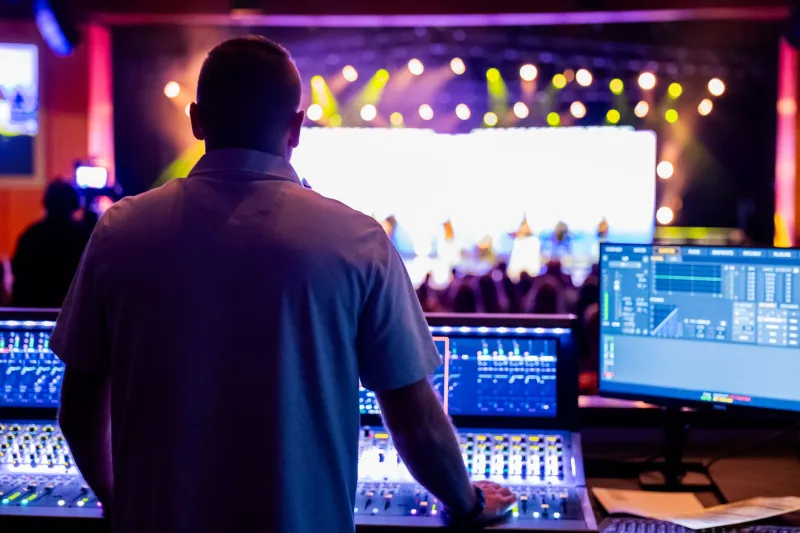
The crowd is screaming. The guitarist hits the first chord of the song everyone came to hear. And at the back of the room, in a tiny booth surrounded by cables and empty Red Bull cans, someone presses a button and the world changes colour.
You don't notice them. You're not supposed to. But that person — usually freelance, almost always underpaid, frequently working on four hours' sleep — just made your night.
Britain's live lighting technicians are among the most skilled and least celebrated people in the entertainment industry. This is their story.
Learning the Craft Nobody Teaches You Formally
Ask most working lighting designers how they got into it and the answer is rarely a formal qualification. It tends to involve a school production, a youth theatre, a mate who needed someone to 'sort the lights' for a gig at the local pub. The industry has traditionally been built on apprenticeship and instinct, with knowledge passed sideways between peers rather than down from institutions.
That's changing slowly. Several colleges now offer technical theatre and live events courses that include lighting design as a discipline. But the consensus among experienced practitioners is that the classroom only takes you so far. The real education happens in the rig — learning why a particular lamp placement creates a harsh shadow, understanding how different colours read differently at different intensities, developing the muscle memory to hit a cue at the exact right moment without watching your hands.
'You learn by doing it wrong,' one touring LD (lighting designer) based in Birmingham told me. 'You create a beautiful look in the afternoon soundcheck and then the band walks on, the room fills with people, and the whole thing looks completely different. The body heat alone changes how the haze sits in the air. You adapt or you don't come back.'
From Intimate Club to Arena: The Same Instinct, Different Scale
There's a common assumption that lighting design is primarily an arena-level concern — the kind of production value reserved for stadium tours with six-figure budgets. In reality, some of the most demanding and creative work happens in small venues, where the constraints are tighter and the margin for error is zero.
At a 200-capacity club, you might be working with a fixed house rig, a laptop, and a conversation with the band that lasted ten minutes. There's no rehearsal, no video screens to fall back on, no pyrotechnics to distract from a missed cue. It's just you, the music, and whatever you can make happen with what's bolted to the ceiling.
Veterans of both ends of the scale often say the smaller rooms are where the real craft lives. At arena level, the show is extensively pre-programmed and rehearsed. The LD is executing a plan. In a club, they're improvising — reading the room, reading the band's energy, making real-time decisions that can transform an average set into something genuinely memorable.
The LED Revolution and Its Discontents
The shift from traditional tungsten and discharge lamps to LED technology has transformed what's physically possible in live lighting. Colours that once required gels and multiple fixtures can now be dialled up on a single unit. Moving heads that would have been prohibitively expensive for smaller tours are now within reach of mid-level productions. The efficiency gains are real and significant.
But not everyone in the industry is celebrating unreservedly. There's a warmth — literally and aesthetically — to traditional tungsten fixtures that LED has struggled to fully replicate. Several experienced designers describe the older equipment as more 'forgiving', producing light that flatters performers and feels organic in a way that cold LED precision sometimes doesn't.
There's also the question of what the technology does to the creative process. When everything is possible, the discipline of making meaningful choices becomes more demanding, not less. 'The gear is incredible now,' says one freelance designer who's worked venues from Glasgow to Brighton. 'But you can tell when someone's just thrown every effect at the wall. The best lighting is still the lighting you don't consciously notice — it just makes you feel something.'
The Human Instinct That Can't Be Automated
Given how comprehensively technology has automated other aspects of live production, it's worth asking whether lighting design is vulnerable. The honest answer from people working in the field is: not really, and here's why.
Pre-programming can handle a set list that never changes. It can execute a timed sequence with mechanical precision. What it cannot do is respond to the moment when a singer unexpectedly drops to their knees during a quiet verse, or when the crowd's energy shifts in a way that calls for the whole room to go dark and intimate rather than explosive. Those decisions require someone who is listening, feeling, and thinking — not just executing.
The best lighting designers describe their relationship with the music as almost physical. They know the songs well enough to anticipate what's coming. They read the band's body language. They're having a silent conversation with the performance in real time, and the light is their half of the dialogue.
An Invisible Craft, Quietly Essential
At the end of a gig, the applause is for the band. The crew get a nod at best, a mention in the programme if they're lucky. The person who spent the last two hours painting the stage in colour, building atmosphere, making the whole thing feel like an event rather than a rehearsal — they're already packing down the rig.
Next time you're at a show and something makes you catch your breath — a light cue that hits at exactly the right moment, a colour change that somehow expresses what the song is about — take a second to look towards the back of the room.
Somebody back there just did something brilliant. They just don't expect you to notice.